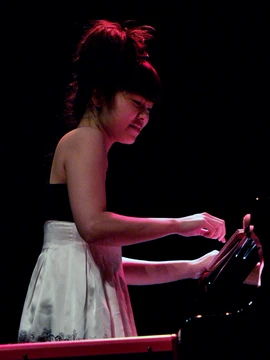
Atsuko Hashimoto
Japanese Hammond B-3 organist who performed in Japan and the United States.

Atsuko Hashimoto is a Japanese jazz musician from Osaka, Japan, known for playing the Hammond B-3 electronic organ. She has performed in Japan and the United States and has recorded five albums of organ trio and organ quartet jazz.
- born
- Not specified in source
- died
- Not specified in source
- field
- Jazz musician
- nationality
- Japanese
- known_for
- Hammond B-3 organ performances and recordings
Lore & Background
Atsuko Hashimoto first played the organ at age four, starting with popular songs and jazz standards. She trained in classical music for several years before specializing in jazz. At 18, she began working for Hammond Japan as a certified instructor, demonstrating organs and giving lessons. In 1991, she became the house organ player at the Don Shop in Osaka, and the following year she fronted her own organ quartet at the Osaka Jazz Festival and Naniwa Arts Festival, leading to collaborations with Makoto Ozone and Terumasa Hino.
Hashimoto debuted in the United States in 1999, playing at clubs in New Orleans and Jazz at Pearl's in San Francisco. In 2000, she toured Japan with "Brother" Jack McDuff and his band, and shared a bill with Dr. Lonnie Smith at Blue Note Osaka. She returned to California in 2001, performing at the San Jose Jazz Festival, The Baked Potato, and the Kuumbwa Jazz Center. In 2002, drummer Jeff Hamilton heard about her electrifying performances at the Don Shop and later sat in with her, leading to two recorded CDs together.
Reader's Guide
Atsuko Hashimoto's significance lies in her role as a Japanese female Hammond B-3 organist who gained recognition in both Japan and the United States. Her career illustrates the international reach of jazz organ traditions, as she performed with notable American musicians such as Jeff Hamilton, Houston Person, and Bruce Forman. Her recordings, including collaborations with Hamilton and guitarist Yutaka Hashimoto, showcase organ trio and quartet formats. Hashimoto's style, described by her first label as evoking pre-Jimmy Smith era organists like Wild Bill Davis and Milt Buckner, reflects a connection to earlier jazz organ traditions. Her technical approach—wearing gloves or taping her fingers for smooth glissandi—demonstrates a practical adaptation to the instrument. By headlining festivals and clubs in the U.S. and Japan, and receiving multiple awards in Osaka, she contributed to the global appreciation of Hammond B-3 jazz. Her legacy is preserved through her five albums and continued performances.
Did You Know?
- Atsuko Hashimoto first played the organ at age four, beginning with popular songs and jazz standards.
- She became a Hammond-certified instructor at age 18, demonstrating organs and giving lessons for Hammond Japan.
- In 2002, drummer Jeff Hamilton heard about her from other musicians and later sat in with her, leading to two recorded CDs together.
- She often wears gloves or tapes her fingers before playing to enable smooth, fast glissandi without injury.
Early Training and the Road to Jazz
Atsuko Hashimoto first touched an organ at age four, working through popular songs and jazz standards before committing to a classical music education that spanned several years. This dual foundation—classical discipline layered over an early love of jazz—shaped her approach long before she ever performed publicly. At eighteen, she entered the world of Hammond Japan, where she demonstrated organs and taught lessons as a certified instructor, deepening her technical command of the instrument she would later make her own. The pivotal moment came in 1991 when she became the house organist at the Don Shop in Osaka. The following year, she fronted her own organ quartet at both the Osaka Jazz Festival and the Naniwa Arts Festival, appearances that opened doors to collaborations with pianist Makoto Ozone and bandleader Terumasa Hino. By the early 1990s she had also married guitarist Yutaka Hashimoto, a partnership that would extend into decades of musical collaboration and shared touring life.
The Jeff Hamilton Encounter and American Breakthrough
Hashimoto first stepped onto American soil in 1999, playing New Orleans clubs and sharing the stage at San Francisco's Jazz at Pearl's with guitarist Bruce Forman and drummer Vince Lateano. But the encounter that would define her international career arrived in 2002, when drummer Jeff Hamilton—touring Japan with Diana Krall—heard from fellow musicians about a young woman captivating late-night audiences at the Don Shop with her organ work. After his own set in Osaka, Hamilton went to hear her. A few songs in, he asked to sit in, and the resulting jam session crystallized in him a desire to tour and record with her. That desire materialized in two collaborative CDs and supporting tours. By 2006, the trio of Hashimoto, Hamilton, and tenor saxophonist Houston Person was commanding standing ovations at venues from the San Diego Museum of Art to the West Coast Jazz Party in Irvine, where they performed under the billing of the Organ Magic Trio.
Musical Style and Technical Craft
Hashimoto's repertoire centers on jazz standards, which she reimagines through extended, expressive solos. Her own label, YS organ-ize Records, has characterized her tonal palette as evoking the pre-Jimmy Smith era, with touches of Wild Bill Davis, Milt Buckner, and Jackie Davis—pointing to a warm, blues-inflected approach rather than the harder-driving modern organ style. She routes her Hammond B-3 through one or two Leslie speakers, giving her lines a swirling, vocal quality. A distinctive practical detail: before performances she often wears gloves or tapes her fingers, a measure that allows her to execute rapid, smooth glissandi without injuring her hands. This combination of vintage tonal sensibility, physical dexterity, and a deep well of standard tunes gives her playing a timeless, almost conversational quality that has drawn both veteran organists and younger audiences across Japan and the United States.
Recognition and Peak Performances
In 2003, at the 40th Naniwa Arts Festival in Osaka, Hashimoto was honored with the Shoji Nakayama Jazz Award, the Progressive Musician's Prize, and commendations from both the governor of Osaka Prefecture and the city's mayor—recognition that cemented her status as a leading figure in Japanese jazz. Her international profile peaked at the 50th Monterey Jazz Festival in September 2007, where she led the Hammond B-3 Blowout alongside the Joey DeFrancesco Trio; her own trio featured Houston Person and Jeff Hamilton, and the two groups were said to blow out the Night Club. A remarkably dense September 2006 saw her record at Capitol Studios in Los Angeles, perform at the San Diego Museum of Art, appear at the White Noise Music Festival in Sacramento, and play the West Coast Jazz Party. To date, she has released five albums of organ trio and quartet jazz, including Time After Time and Introducing Atsuko Hashimoto, both issued in 2008, and Until the Sun Comes Up in 2011.
Frequently Asked Questions
Who is Atsuko Hashimoto?
Atsuko Hashimoto is a Japanese jazz musician based in Osaka who has built her career around the Hammond B-3 electronic organ. She is recognized for leading small ensembles in the organ trio and organ quartet formats.
What instrument is Atsuko Hashimoto known for playing?
She is specifically associated with the Hammond B-3, the classic electronic organ that has long been a staple in jazz, gospel, and rhythm-and-blues settings.
Where has Atsuko Hashimoto performed?
Her live work spans both Japan and the United States, giving her a footprint in two of the world's major jazz markets.
How many albums has Atsuko Hashimoto recorded?
She has released five albums, all centering on organ trio and organ quartet jazz configurations.
What style of jazz does Atsuko Hashimoto play?
Her recorded output places her squarely in the tradition of the jazz organist, building ensembles around the Hammond B-3 in both trio and quartet settings.
More in Japanese jazz musicians 1-24
Spotted an error? Know more?
This is a living reference — every entry is fact-audited, and reader corrections feed straight into our audit queue. Suggest an edit · See this site's audit record