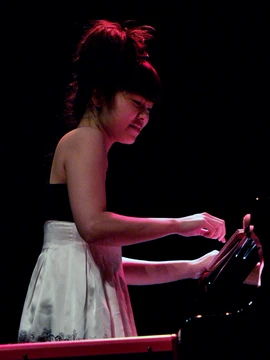
Mikio Masuda
Japanese jazz and jazz fusion keyboardist active from the 1970s.

Mikio Masuda, also known as Mickey Masuda, was born on 14 August 1949 in Osaka, Japan, and is a keyboardist in jazz and jazz fusion. A largely self-taught musician, he started on bass at sixteen, then moved to piano and began playing in Osaka clubs. In 1969 he relocated to Tokyo, and by the early 1970s he was active in the Japanese jazz scene. He played in a quartet with Motohiko Hino, Terumasa Hino, and a bassist (often Yoshio Ikeda), and in 1973 they performed at the International New Jazz Meeting at Burg Altena, Germany. His first album, *Trace*, came out in 1974 on East Wind Records, and two years later he released the jazz-fusion record *Mickey's Mouth*.
- born
- 14 August 1949
- field
- Jazz and jazz fusion
- nationality
- Japanese
- known_for
- Keyboardist, debut album Trace, jazz-fusion album Mickey's Mouth
Lore & Background
Mikio Masuda was largely self-taught, starting on bass at age 16 before switching to piano and performing in clubs in Osaka. In 1969 he moved to Tokyo, and by the early 1970s he was playing in the Japanese jazz scene, notably in a quartet with Motohiko Hino, Terumasa Hino, and a bassist (often Yoshio Ikeda). The quartet performed in 1973 at the International New Jazz Meeting at Burg Altena, Germany. In 1974 he recorded his debut album Trace for East Wind Records, followed by the 1976 jazz-fusion album Mickey's Mouth. He also worked with musicians such as Kosuke Mine, Hidefumi Toki, Takao Uematsu, Hiroshi Murakami, Kazumasa Akiyama, Kazumi Watanabe, and Eri Ono.
Reader's Guide
After moving to New York City in 1978, Masuda created the album Corazón and worked with David Matthews. In two later New York stays, he recorded the trio album Black Daffodils in 1996 with Ron Carter and Lewis Nash, and Blue Dumplings in 1998 with Ron Carter and Grady Tate. Between 1972 and 1998, he was involved in 46 recording sessions, most recently with Chie Ayado. His discography includes albums such as Moon Stone (1978), Goin' Away (1979), Silver Shadow (1980), Mickey Finn (1981), Chi Chi (1982), Dear Friends (1986), and Smokin' Night (1987). Masuda's work spans jazz and jazz fusion, and his collaborations with prominent American musicians like Ron Carter and Lewis Nash highlight his cross-cultural influence. His legacy is marked by a prolific recording career and a role in bridging Japanese and American jazz scenes.
Did You Know?
- Masuda played bass at age 16 before switching to piano.
- He performed in 1973 at the International New Jazz Meeting at Burg Altena, Germany.
- His debut album Trace was released in 1974 on East Wind Records.
The Self-Taught Path from Osaka to Tokyo
Mikio Masuda arrived on the world on 14 August 1949 in Osaka, Japan, a city whose club circuit would shape his earliest musical instincts. Largely self-taught, he first picked up the bass at the age of sixteen, spending formative years performing in the city's various venues before ultimately switching his allegiance to the piano. That instrument would become his lifelong voice. By the late 1960s, Masuda had established himself as a working musician in Osaka's club scene, honing his technique through nightly performance rather than formal conservatory training. In 1969, he made the decisive move to Tokyo, placing himself at the center of Japan's rapidly evolving jazz community. That relocation set the stage for everything that followed: a career defined by restless experimentation, a willingness to cross genre boundaries, and a keyboard style that blended the lyrical sensibility of straight-ahead jazz with the rhythmic energy of fusion. His early Osaka years, though brief in the grand timeline of his output, established the independent, club-rooted ethos that would characterize his work for the next three decades.
Quartets, Festivals, and the First Recordings
In the early 1970s, Masuda embedded himself in Tokyo's thriving jazz ecosystem, most notably as the keyboardist in a quartet alongside Motohiko Hino, Shunzo Ohno, and Terumasa Hino. That group's international exposure came in 1973, when they performed at the International New Jazz Meeting held at Burg Altena in Germany, a moment that placed a Japanese ensemble on a European festival stage. Back home, Masuda continued to expand his network, collaborating with figures such as Kosuke Mine, Hidefumi Toki, Takao Uematsu, Hiroshi Murakami, Kazumasa Akiyama, Kazumi Watanabe, and Eri Ono. His solo recording career took off in 1974 with Trace, released on East Wind Records and featuring Terumasa Hino, Hideo Miyata, Takao Uematsu, Tsutomu Okada, and Motohiko Hino. Two years later, the jazz-fusion album Mickey's Mouth, also on East Wind, showcased a more rhythmic, band-oriented approach with Masayoshi Saito, Osamu Kawakami, and Guilherme Franco. The same year saw him contribute to Hidefumi Toki's Sky View on Frasco Records, underscoring his versatility across straight-ahead and fusion contexts.
New York and the Ron Carter Trios
Masuda's first transatlantic chapter began in 1978 when he relocated to New York City. There he recorded Corazón for Electric Bird Records, a session that brought together Anthony Jackson on bass, Bernard Purdie on drums, and Sammy Figueroa, reflecting the cosmopolitan energy of the New York scene. He also worked alongside David Matthews during that period. A second album, Goin' Away, and a third, Silver Shadow, followed on the same label in 1979 and 1980 respectively. After a period back in Japan—where he released Mickey Finn in 1981, Chi Chi in 1982, Dear Friends in 1986, and Smokin' Night in 1987—Masuda returned to New York for two further stays. In 1996 he recorded the trio album Black Daffodils for JVC with legendary bassist Ron Carter and drummer Lewis Nash. Two years later, Blue Dumplings paired him again with Carter, this time alongside Grady Tate. These late collaborations, spanning nearly two decades from his first New York visit, demonstrate a sustained dialogue between Japanese and American jazz traditions.
A Catalogue of Collaboration and a Lasting Footprint
Between 1972 and 1998, Masuda participated in forty-six recording sessions, a figure that speaks to both his prolific output and his reputation as a sought-after sideman across the Japanese and international jazz worlds. His discography stretches across at least seven different labels—East Wind, Frasco, Better Days, Electric Bird, Zen, XEO Invitation, and JVC—evidence of a career that refused to be confined to a single aesthetic or market. Known to many as Mickey Masuda, he navigated the spectrum from straight-ahead quartet work to full-blown fusion, from cosmopolitan New York sessions to intimate trio settings. His most recent documented collaboration was with vocalist Chie Ayado, closing out a period of nearly three decades of active recording. The breadth of his collaborators—from the Hino brothers and Kosuke Mine in Japan to Ron Carter, Lewis Nash, Grady Tate, and Anthony Jackson in the United States—paints a picture of a keyboardist whose musical curiosity and technical command made him a natural fit in ensembles spanning multiple continents and sub-genres.
Frequently Asked Questions
Who is Mikio Masuda?
Mikio Masuda, widely known by his nickname Mickey Masuda, is a Japanese keyboardist born in Osaka on 14 August 1949 who has been a steady presence in the jazz and jazz fusion world since the early 1970s. He is largely self-taught, having first played bass as a teenager before switching to piano and working the Osaka club circuit before moving to Tokyo in 1969.
What is Mikio Masuda's role in a band?
Masuda functions as the keyboardist, covering both acoustic piano and electric keys across straight-ahead jazz and fusion ensembles. His self-taught background gives his comping and soloing a loose, intuitive feel that sets him apart from conservatory-trained players of his generation.
What is Mikio Masuda's debut album?
His first record as a leader, Trace, was issued in 1974 on East Wind Records. It crystallized the club-based sound he had been developing in Tokyo and Osaka and is the entry point most listeners use when exploring his catalog.
What is Mickey's Mouth and why do fans mention it?
Mickey's Mouth is a jazz-fusion album recorded under Masuda's stage nickname, highlighting his move toward heavier, rhythm-driven arrangements with electric keyboards. It is routinely cited alongside Trace as one of the two records that best define his contribution to Japanese fusion in the 1970s.
Did Mikio Masuda play with the Hino brothers?
Yes; in the early 1970s he sat in a quartet with Motohiko Hino, Terumasa Hino, and bassist Yoshio Ikeda. That group represented Japan at the 1973 International New Jazz Meeting in Burg Altena, Germany, giving Masuda one of his earliest high-profile international appearances.
More in Japanese jazz musicians 1-24
Spotted an error? Know more?
This is a living reference — every entry is fact-audited, and reader corrections feed straight into our audit queue. Suggest an edit · See this site's audit record