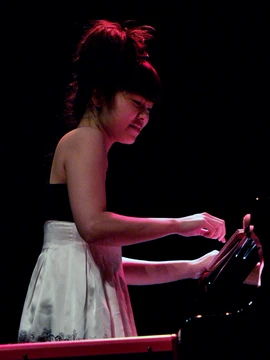
Keiko Matsui
Japanese keyboardist and composer of smooth jazz and New-age music.

Keiko Matsui (born 26 July 1961) is a Japanese keyboardist and composer known for blending smooth jazz and New-age music. She began piano lessons at age six and later studied at Japan Women's University and the Yamaha Music Foundation, eventually launching a solo career that produced numerous albums, several of which charted on Billboard's jazz rankings.
- known_for
- Smooth jazz and New-age music; albums such as Sapphire (No. 1 on Billboard Contemporary Jazz chart) and Soul Quest (No. 6 on Billboard Contemporary Jazz chart)
Lore & Background
Keiko Matsui was born in Tokyo, Japan, as Keiko Doi. Her mother, Emiko, took her to her first piano lesson in the June following her sixth birthday, a timing that Japanese tradition holds will lead a child to continue those studies for a long time. She studied piano throughout her school years, focusing initially on classical music, but in junior high school she developed an interest in jazz and began composing her own music. She studied children's culture at Japan Women's University and later studied at the Yamaha Music Foundation. She started the band Cosmos, which recorded four albums, and made her solo debut with A Drop of Water (1987), recorded with her husband Kazu Matsui. She signed with MCA for No Borders and Under Northern Lights, then with White Cat, where Sapphire (1995) reached No. 1 on the Billboard Contemporary Jazz chart. Later albums include The Road (2011), recorded with Richard Bona, Vinnie Colaiuta, Jackiem Joyner, and Kirk Whalum, and Soul Quest (2013), which reached No. 6 on the Billboard Contemporary Jazz chart. Many of her songs have been arranged by American composer Gary Stockdale.
Reader's Guide
Keiko Matsui's significance lies in her sustained career as a Japanese female instrumentalist in the predominantly male and Western smooth jazz and New-age genres. Her music blends Western and Eastern elements, and she describes composing as a spiritual process of catching notes from silence. She often references nature in her song titles, with a special fascination for the moon. Beyond her recordings, Matsui engaged in charity work: her 1997 mini-CD A Gift of Hope supported the Y-ME National Breast Cancer Organization, and proceeds from A Gift of Life went to the National Marrow Donor Program to help ethnic minorities find marrow donors. Royalties from Wildflower supported the United Nations World Food Programme, and she performed at the United Nations Headquarters in 2003 for that program. Her legacy includes multiple charting albums, a distinctive spiritual and nature-inspired compositional approach, and a commitment to using her music for philanthropic causes.
Did You Know?
- Keiko Matsui's mother took her to her first piano lesson in the June following her sixth birthday, a timing believed in Japanese tradition to encourage long-term study.
- Her album Sapphire (1995) reached No. 1 on the Billboard Contemporary Jazz chart.
- She performed at the United Nations Headquarters on December 17, 2003, to benefit the World Food Programme.
- Many of her songs have been arranged by American composer Gary Stockdale.
Early Life & Musical Formation
Keiko Matsui was born Keiko Doi on July 26, 1961, in Tokyo. Her musical journey began the very month she turned six, when her mother Emiko brought her to a piano lesson. In Japanese cultural tradition, introducing a child to a pursuit at this precise age is believed to anchor that path for a lifetime, and the saying proved accurate for Matsui. She carried piano studies through every year of her schooling, though her foundational training was rooted in classical repertoire. The shift came during junior high school, when jazz music captured her imagination and she started writing her own compositions. After graduating from Japan Women's University, where she focused on children's culture, she pursued further study at the Yamaha Music Foundation. There she co-founded the band Cosmos, which went on to record four albums between 1980 and 1985, laying the groundwork for the solo artist she would soon become.
Career Trajectory & Major Milestones
Matsui's solo career launched in 1987 with A Drop of Water, recorded under the Passport label alongside her husband Kazu Matsui. She then signed with MCA, releasing Under Northern Lights and No Borders in the late 1980s and early 1990s. A pivotal moment arrived in 1992 when she joined the White Cat label, a home that would produce several of her most celebrated recordings. Her 1995 album Sapphire climbed to the top of Billboard's Contemporary Jazz chart, a landmark achievement that cemented her international profile. After a period with the Countdown and Narada labels, she moved to Shanachie in 2011, producing The Road with an all-star lineup including Richard Bona, Vinnie Colaiuta, Jackiem Joyner, and Kirk Whalum. That same year she collaborated with Bob James on the album Altair & Vega. Her 2013 release Soul Quest reached number six on the jazz chart, and she continued recording through the 2010s and into 2023 with Euphoria, demonstrating a career spanning more than three decades of consistent output.
Artistic Philosophy & Sound
Matsui's compositional approach is deeply spiritual and cross-cultural. She deliberately weaves Western harmonic language with Eastern musical sensibilities, creating a sound that feels simultaneously familiar and otherworldly. She describes the creative process in almost mystical terms, saying melodies arrive to her "from another space, another dimension," and that she is essentially "catching notes from the silence and then simply placing them together." For her, music is not merely entertainment but a sacred inheritance, a gift passed from the souls of the past to the children of the future. She has written that people are connected through music "as the Ocean connects the continents," underscoring her belief that music holds the power to unite and transform lives. This reverence for the natural world permeates her catalog: song titles frequently invoke plants, animals, elemental forces, and celestial bodies, with the moon appearing as a recurring motif across multiple compositions.
Charity & Social Impact
Beyond her recordings, Matsui has consistently channeled her platform toward humanitarian causes. In 1997 she released the mini-CD A Gift of Hope, with proceeds directed to the Y-ME National Breast Cancer Organization, and her music featured in a Lifetime television special on the same subject. That same year she performed at an ice skating event benefiting the Susan G. Komen for the Cure foundation. Her 2001 EP A Gift of Life sent its proceeds to the National Marrow Donor Program and the Marrow Foundation, specifically supporting the initiative to encourage people of Asian and other ethnic minority backgrounds to register as bone marrow donors, improving matching odds for patients in need. The royalties from her 2004 album Wildflower were pledged to the United Nations World Food Programme, a commitment she honored by performing live at UN Headquarters in New York City on December 17, 2003, in direct support of the program's mission.
Frequently Asked Questions
Who is Keiko Matsui?
She is a Japanese keyboardist and composer born on July 26, 1961, who built an international solo career by fusing smooth jazz with New-age sensibilities.
What style of music is Keiko Matsui known for?
Her work sits at the intersection of smooth jazz and New-age music, creating an accessible, atmospheric sound that reaches well beyond traditional jazz audiences.
What are Keiko Matsui's biggest hit albums?
Sapphire reached the top spot on Billboard's Contemporary Jazz chart, while Soul Quest climbed to number six on the same list, both showcasing her signature blend of electronic textures and melodic piano.
Where did Keiko Matsui train before launching her solo career?
She began piano lessons at age six and later pursued formal study at Japan Women's University and through the Yamaha Music Foundation before stepping out as a solo artist.
Why is Keiko Matsui important in Japanese jazz?
She helped bring Japanese keyboard-driven jazz to mainstream international charts, proving that a smooth, New-age-influenced approach could compete alongside more traditional jazz forms on Billboard's rankings.
More in Japanese jazz musicians 1-24
Spotted an error? Know more?
This is a living reference — every entry is fact-audited, and reader corrections feed straight into our audit queue. Suggest an edit · See this site's audit record